Description
Remembrance
Memory & Clarity Tea
Nootropic · Circulatory · Aromatic
The Shortest Road to Memory
Every sense you have is routed through the thalamus first and sorted before it reaches you — every one but smell.
Olfaction is the exception. Scent travels from the nose to the olfactory bulb and from there straight into the limbic system, arriving at the amygdala and the hippocampus without being processed by anything in between. The hippocampus is where memories are consolidated. The amygdala is where they are given weight. Smell is the only sense that opens directly onto both.
This is why a scent can return an entire year of your life in under a second, and why the returned memory arrives whole, with its feeling already attached, rather than assembled piece by piece the way a deliberately recalled one is.
Every tradition that works with memory has known this without the anatomy. Incense, smudge, anointing, the herb crushed between the fingers before study. This tea is aromatic by design. Some of it works through the gut and the blood over weeks. Some of it works the moment the steam reaches you.
Medhya Rasayana
Ayurveda keeps a category for this: medhya rasayana. Medhya means that which nourishes the intellect. Rasayana is the class of restoratives taken over long periods to rebuild rather than to stimulate — the medicines of longevity, not of effect.
Both bacopa and gotu kola sit in this category, and both carry the name brahmi in one region or another — a name that traces to Brahman, the expanding principle, the thing consciousness does when it is not constricted. That two different plants, growing in two different parts of India, were each given that name tells you what practitioners noticed in them.
The word to hold onto is rasayana. These are not stimulants and this tea is not a nootropic in the sense the word is now used. The clinical trials on bacopa show its effects on memory acquisition and recall emerging over eight to twelve weeks, not in an afternoon. What you feel on the first day is the peppermint and the rosemary. What you are actually taking it for arrives slowly, and only if you keep drinking it.
Drink it for a season. That is the whole instruction.
Rosemary, for Remembrance
The European line runs just as long. Greek students are said to have worn rosemary in their hair while studying. It was carried at funerals and at weddings — the herb of not forgetting, in both directions. There’s rosemary, that’s for remembrance, Ophelia says, handing it out, and Shakespeare expected the audience to already know why.
Modern work has been unusually kind to the old association. Rosemary’s aroma alone — 1,8-cineole, absorbed through the lungs and detectable in blood — has been linked in controlled studies to improved performance on memory tasks, with the effect scaling to how much of the compound is measured in the bloodstream. The garland was not superstition. It was a delivery method.
The sages belong to the same family and carry much of the same chemistry, and the Salvias have their own respectable record in trials of cognition and recall.
The Herbs
Bacopa (Bacopa monnieri) — The most studied plant here by a wide margin. A creeping marsh herb of India, used as medhya rasayana for two millennia and now supported by repeated controlled trials in healthy adults and in the elderly, showing improvement in memory acquisition, delayed recall, and speed of information processing. Its bacosides appear to work on synaptic signalling and on the antioxidant status of hippocampal tissue. It is slow, it is cumulative, and it rewards patience.
Gotu kola (Centella asiatica) — The plant of long life in Sinhalese and Ayurvedic tradition, and the one in this blend that works on tissue rather than on signal. Its triterpenes — asiaticoside, madecassoside — support microcirculation and connective tissue integrity, which is the least glamorous and most literal way to feed a brain: by improving what reaches it. It is also quietly anxiolytic, and a mind under less pressure remembers more.
Rosemary (Salvia rosmarinus) — Aromatic, circulatory, and warming to the head. Rosmarinic acid and 1,8-cineole, arriving both through the cup and through the steam.
White sage (Salvia apiana) — Resinous and strongly aromatic, from the chaparral of southern California, where it is a sacred plant to the Cahuilla, Chumash, Tongva, Kumeyaay and neighbouring peoples. Clearing, drying, and unmistakable.
Peppermint (Mentha × piperita) — Cooling and immediately alerting. Peppermint aroma has its own small literature on attention and alertness, and it does in minutes what the rest of the formula does in months. It is also what makes the cup pleasant enough to keep drinking for a season.
To Use
One teaspoon per cup. Water just off the boil, covered, steeped ten minutes. Breathe the steam before you drink.
Once or twice daily, with food. Bacopa is easier on the stomach taken alongside a meal, and some traditions pair it with a little fat for the same reason.
Take it as a course — eight to twelve weeks at minimum. It is not a cup you reach for on the morning of an exam.
Cautions
Not for use during pregnancy or while nursing.
Consult your healthcare provider before use if you take any medication, particularly thyroid medication, sedatives, or medication affecting the liver. Not for use with existing liver conditions without practitioner guidance. May aggravate reflux in those prone to it. Discontinue two weeks before surgery.
May cause digestive upset if taken on an empty stomach.
This tea is a traditional botanical preparation intended to support clarity and cognitive resilience. It is not a treatment for any disease and is not a substitute for medical care.
Blended in small batches in Taos, New Mexico.

 Strong Heart Tea
1 × $19.00
Strong Heart Tea
1 × $19.00  Mantle and Ward Ancestral Bath
1 × $20.00
Mantle and Ward Ancestral Bath
1 × $20.00  Muscle, Bone & Nerve Mender
1 × $18.00
Muscle, Bone & Nerve Mender
1 × $18.00  Male Sex Magic
1 × $34.00
Male Sex Magic
1 × $34.00 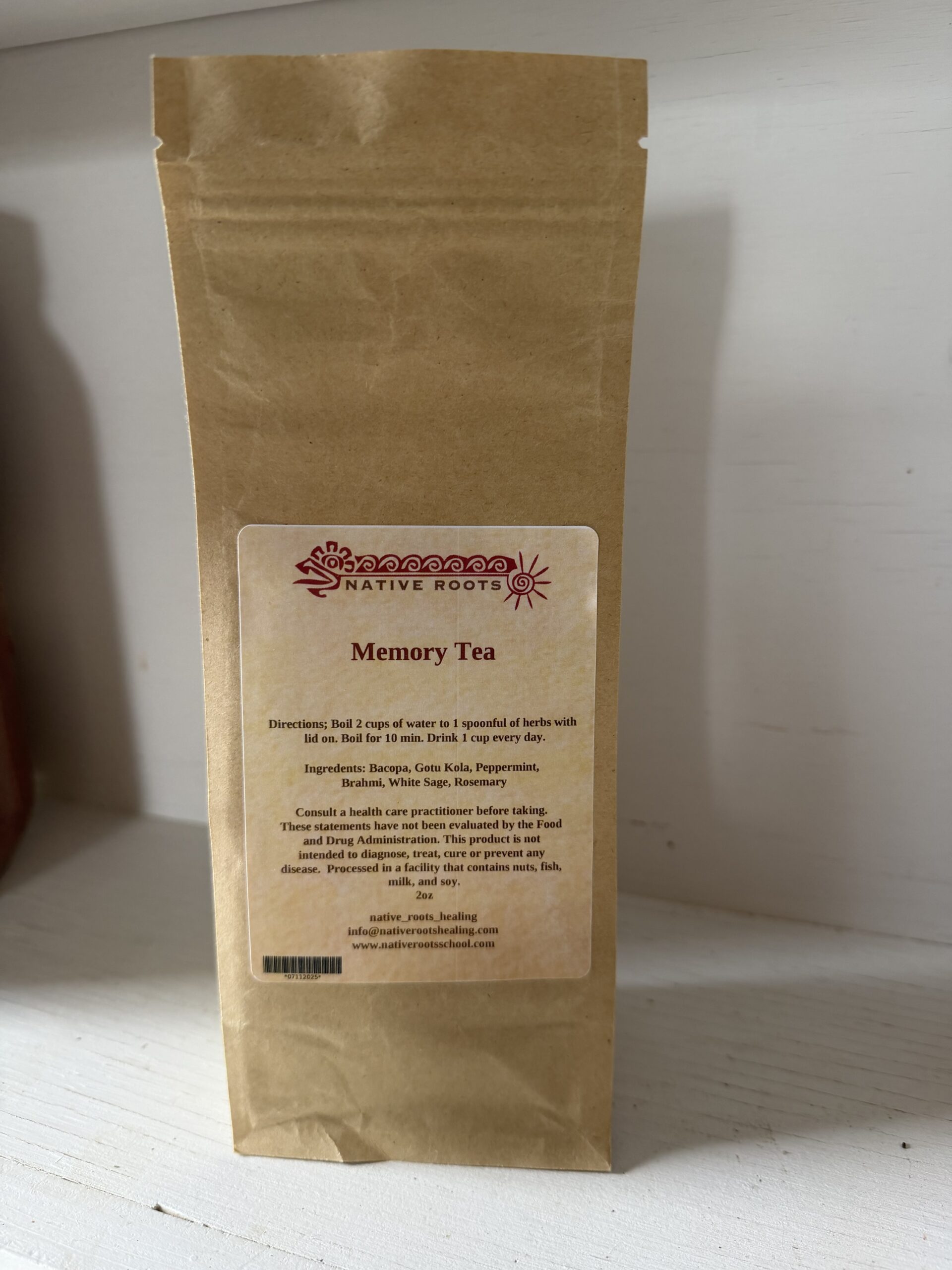




Reviews
There are no reviews yet.