- Call (914) 400-7558
- info@nativerootshealing.com
- Sign Up

No products in the cart.
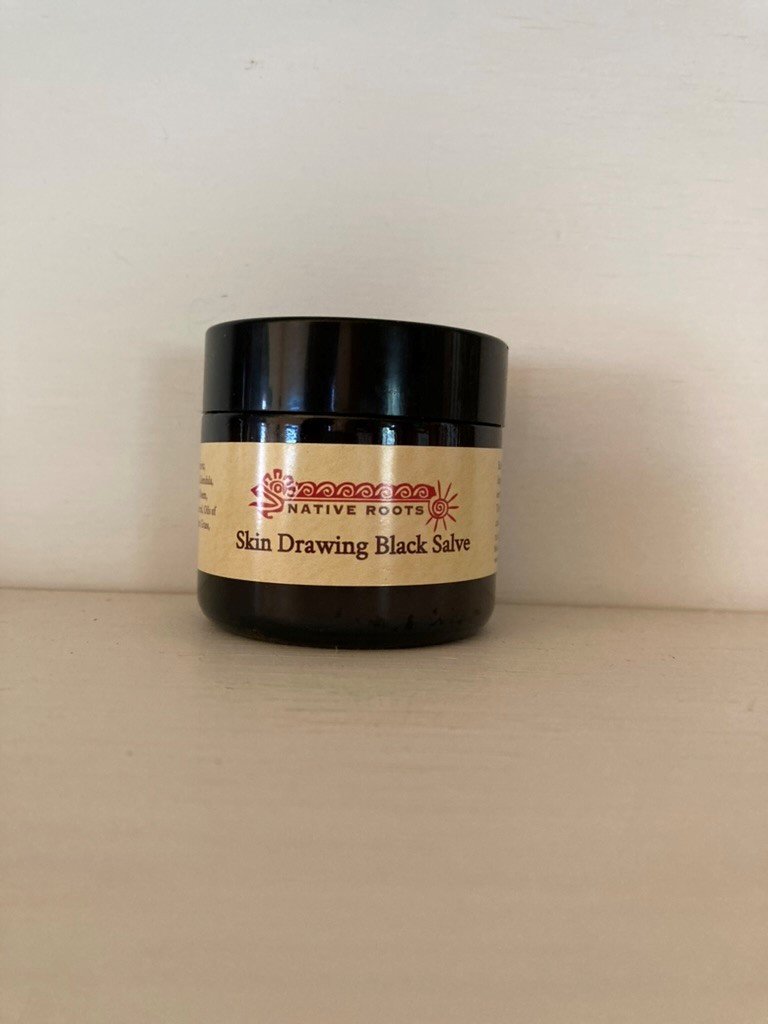
Herbal Drawing Salve
Drawing · Antimicrobial · Vulnerary
A drawing salve does not pull. Nothing applied to skin exerts suction.
What it does is soften and open. Occlusive oils hold moisture against the stratum corneum until the tissue hydrates and swells, which loosens the grip on whatever is lodged in it. Mucilage and resin keep the site soft rather than letting it close over. Warmth and increased local circulation bring immune cells and fluid to the area. Inflammation is not suppressed — it is given somewhere to go.
Then the body does the work. A splinter walks itself out over two days. A boil comes to a head and opens. An abscess, which was going to drain either way, drains sooner and more completely.
This is one of the oldest forms of external medicine there is, and it is still the right answer for a surprising share of what happens to skin.
The drawing base. Castor oil is the classic vehicle — thick, occlusive, and used as a drawing and softening agent across several traditions. Marshmallow root and comfrey bring mucilage and allantoin, holding the site soft and moist and feeding cell repair; comfrey’s reputation as knitbone is earned at the surface as much as anywhere. Chamomile is the gentlest anti-inflammatory in the materia medica and the reason the salve is tolerable on angry skin.
The antimicrobials. Chaparral (Larrea tridentata), the great resinous antiseptic of the Chihuahuan desert and the herb every Southwestern practitioner reaches for in a salve — antibacterial, antifungal, and grown within sight of where this is made. Neem, with a comparable reputation across Ayurvedic practice for infected and fungal skin. Black walnut hull, astringent and reliably antifungal. Thyme and wormwood, aromatic and antiseptic. Frankincense, resin and oil both, anti-inflammatory and long used on wounds that are slow to close.
The circulatory and anti-inflammatory. Turmeric, whose curcuminoids work better topically than they ever do swallowed, since absorption is not the obstacle it is by mouth. Ginger, warming and rubefacient, bringing blood to the surface. Red China root (Smilax), an alterative with a long history in stubborn skin conditions. Turkey tail (Trametes versicolor), whose glucans have a modest but genuine literature in wound healing.
The lymphatic. Poke root (Phytolacca) is the traditional external application over congested, swollen, boggy glandular tissue — an Eclectic practice with a century and a half behind it. It is present in a small proportion and it is the reason the cautions below matter.
The vulnerary. Calendula, which belongs in every salve that touches damaged tissue and needs no further argument.
Essential oils. Birch, frankincense, clove, rosemary, lemongrass and balsam fir — analgesic, antiseptic, and warming, in small proportion.
Apply a thin layer to clean, intact skin. Cover with a bandage or cloth if you want it to stay put and stay warm, which improves it.
Reapply once or twice daily. For a splinter or thorn, give it a day or two before going after it with tweezers — it will usually come up on its own or come out easily.
Warmth helps. A hot cloth over the dressing, or applying after a bath, does more than more salve does.
For external use only.
Do not apply to deep puncture wounds, or to any wound you cannot see the bottom of. This salve softens and seals the surface, which is the wrong thing to do to a puncture that needs to drain from the depth.
Not for use during pregnancy or while nursing. Not for children. Keep out of reach of children — this preparation contains methyl salicylate, which is hazardous if swallowed.
Keep away from eyes and mucous membranes. Wash hands after applying. Patch test on a small area first; clove and lemongrass oils cause sensitivity in some people. Black walnut will stain skin and fabric brown.
Discontinue if redness, burning or rash develops.
Seek medical attention for any wound with spreading redness, red streaking, fever, or increasing pain; any wound that does not improve within a few days; any swelling or lump that is hard, fixed, painless, or persists more than a few weeks; and any mole, spot or skin lesion that changes in size, shape or colour, bleeds, or will not heal. A salve is not the right tool for any of these, and the sooner they are looked at the better they go.
This preparation is a traditional botanical salve intended to support the skin’s own repair. It is not a treatment for any disease and is not a substitute for medical care.
Made in small batches in Taos, New Mexico.
The ingredients in this salve have been used traditionally to address serious skin growths, ailments and lymph.
Ingredients: Red china root, Turmeric, Frankincense, Ginger, Turkey tails, Poke root, Calendula, Comfrey, Graviola, Black Walnut, Wormwood, Neem, Chamomile, Thyme, Marshmallow root, Chaparral, Castor oil, Grapeseed oil, Olive oil and a Blend of Essential oils, etc
All herbs are wild crafted or organic.
*This information is based on traditional uses. These statements have not been evaluated by the FDA. This product is not intended to diagnose, treat or prevent any disease.
2oz
| Weight | 0.75 lbs |
|---|---|
| Dimensions | 3 × 3 × 3 in |
Only logged in customers who have purchased this product may leave a review.
Bio:
Morgaine Witriol is founder of the Native Roots School of Ancestral, Folk & Herbal Medicine in Taos, NM, a collective of 10 different teachers that teach each about their own ancestral healing modalities. Morgaine is a clinical herbalist, wild crafter, gardener, medicine maker and intuitive being in service to the plant and fungal folk. At her private practice in Taos, NM people can recieve a combination of clinical, spiritual and medical intuitive treatments including bodywork, herbal consults, somatic trauma release, repatterning and reconditioning intergenerational and ancestral wounds, lymphatic drainage, abdominal massage, and sound healing. Morgaine’s focus in her practice aside from trauma work is focused working with people that were diagnosed with cancer, diabetes, arthritis, depression or hard to treat chronic disease that western medicine is stumped by. At Native Roots, Morgaine teaches about reclaiming one’s own ancestral traditions as a displaced person, Jewish Folk Medicine, SW Materia Medica, Herbal Allies for Trauma & Grief, Ethics, Cultural Appropriation, Plant Energetics, Energywork, Clinical Herbalism, Flower Essences, Medicine Making and leads several multi-day field trips doing medicinal plant walks. Really she feels she teaches how to come into relationship with elemental, plant and fungal medicine, and then the indigenous science from all cultures of listening to the body and its layers of epigenetic, ancestral, childhood, organ, and energy center imbalances. Morgaine developed and ran educational programs accredited through the University of NM, has taught at the American Herbalist guild conference twice, UNM Albuquerque and is now teaching at Northern University on herbalism for the nursing department. Her favorite people to teach are doctors, nurses, children and teachers. She has led plant and mushroom walks for the New Mexico Association of Osteopathic Medicine, Flower Hill Institute, presented for Native Plant Society, and taught wellness through plant and mushroom medicine for Taos Municipal Schools Employees.
In 2010 Morgaine lived in Belize and had the opportunity to apprentice tropical medicine with one of the most revered medicine men in the country the late Don Heriberto Cocom for 1.5 years and with his good friend Don Reginaldo Chayeux in Guatemala. She brought groups down to study Mayan medicine, herbalism and abdominal massage with him for 7 years until creator called him home. She collaborated for 10 years with his Nonprofit Association to support the protection of the fully Mayan run rainforest Reserve Bio Itza and brings groups of students to study with him. Morgaine has recognized the importance of honoring healing modalities of all cultures and especially the ones of our own tradition even if they have been forgotten by a few generations.
Morgaine studied at the Northwest School for Botanical Studies, The Dandelion Center, California School for Herbal Studies, The Dhyanna Center, Blue Otter School, Acutonics Institute for Integrative Medicine, Ethnic Studies and Anthropology at the University of Colorado. She often attends herbal and mushroom conferences.
She grew up with an immigrant community and found herself easily honoring the elders that still remembered their own language, their own healing modalities and traditions from that community. It was a journey of many years before she started to look deeper into reclaiming the healing practices of the ancestral traditions that she came from and hopes to share with all people of European descent to remember to honor their own ancestors, to connect to the land and the people that are currently practicing and keeping the context of European tribal healing traditions alive today. She hopes to create a safe space to bridge the intergenerational gap of knowledge, cultural similarities and healing tools to encourage self healing and community healing.
Morgaine worked for Teambuilders counseling Services in 2008 in Taos, New Mexico as a Comprehensive Community Support Specialist teaching “life skills” including communication, stress and anger management, and parenting skills and offering social work opportunities for children and their parents. Later she worked at nonprofit Rocky Mountain Youth Corps with “at risk youth” doing hands-on experiential learning in nature focusing on useful life skills and training once a week for teens. Afterwards she ventured to Guatemala to volunteer at an orphanage and was responsible for 30 girls ages 10-17 as their live in caretaker and teacher for 5 months. in 2011 Morgaine found herself homebound and endured hurricane Sandy’s destruction leaving 13 million people on the East coast without electricity. She coordinated one thousand volunteers a day in Staten Island, New York and spent months doing grass roots disaster recovery with Feeding Family including immediate needs donations and distribution of water, food, respiratory masks, clothing, tho food, medications and animal rehoming, demolition, and later therapeutic urban gardening in elevated community garden beds, fundraising, and more demolition, raw sewage clean up and mold control.
Rates:
$225-375 sling scale for 1.5 hours, $300-500 for 2 hours
Miram’s sessions are intuitive. Her body and words are a vessel for divine healing and often she channels intuitively the heart medicine that supports one to create and develop their own healing. Miriam awakens the self worth, self value and realignment with ones higher self.
A combination of these services is provided in one session. Distance sessions and in person.
$150 deposit is quired in advance
Rates:
$225-375 sling scale for 1.5 hours, $300-500 for 2 hours
By-donation for all New Mexican heritage peoples
Reviews
There are no reviews yet.