- Call (914) 400-7558
- info@nativerootshealing.com
- Sign Up

No products in the cart.
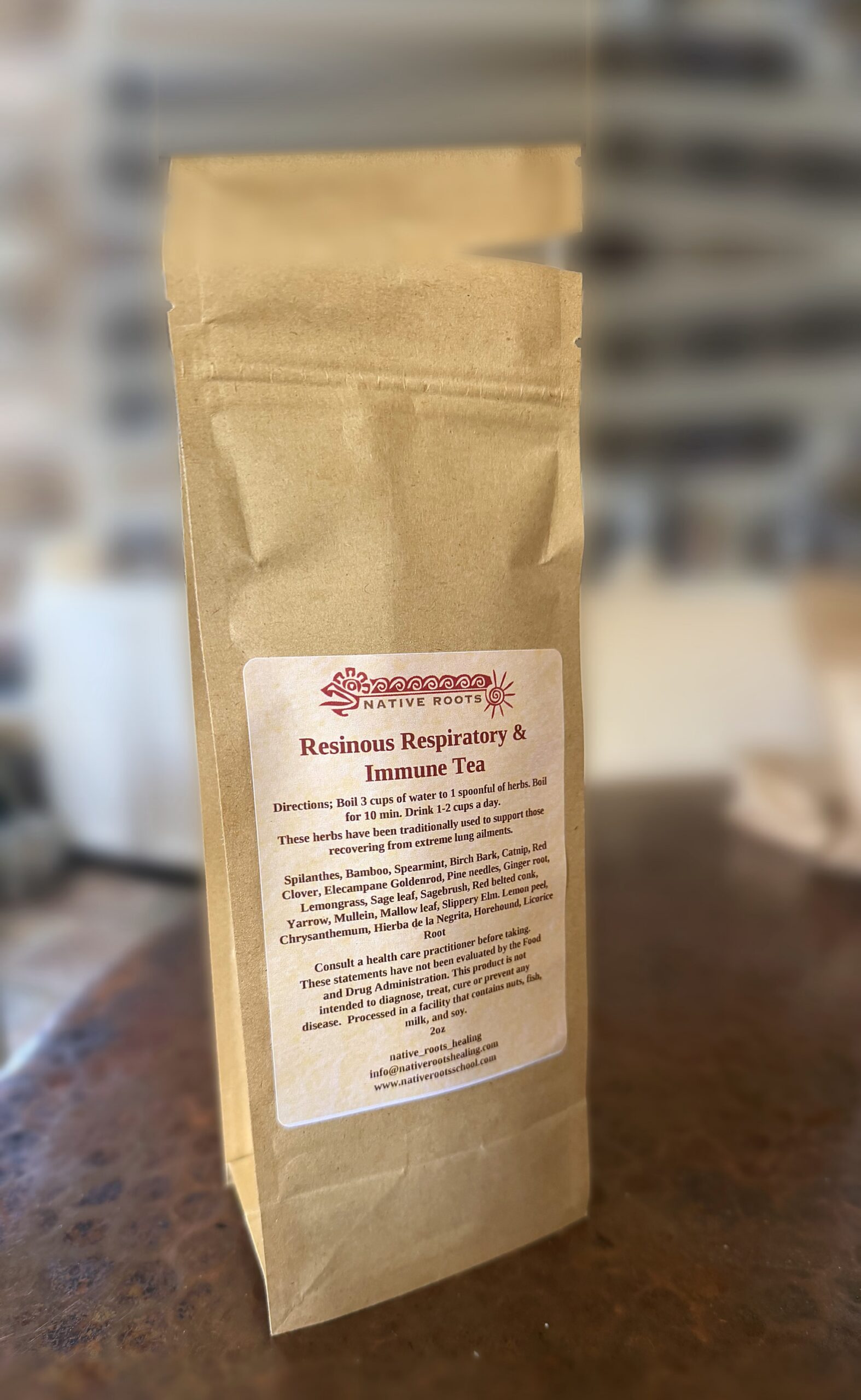
Resinous Respiratory & Immune Tea
A Bioregional Brew for the Cold Season
Diaphoretic · Expectorant · Demulcent
The Logic of Resin
When a conifer is wounded, it bleeds pitch.
The resin floods the breach, hardens over it, and seals the tree against the fungi and beetles that would otherwise enter. It is antimicrobial, it is volatile, and it is the tree’s entire immune response held in one substance. A pine does not have circulating white cells. It has resin, and resin is enough to carry a ponderosa through five hundred winters in hard country.
This tea is built on that logic. The resinous plants — pine, sagebrush, the conk that grows on dying conifers — are borrowing the tree’s answer to breach and infection and lending it to lungs. The volatile fraction is exhaled through the alveoli within minutes of drinking, which means these plants arrive at the respiratory tissue directly, carried on the breath rather than only through the blood. You can smell them leaving.
That is not a metaphor dressed up as a mechanism. It is how volatile oils behave, and it is why every tradition living near conifers arrived independently at steaming, smoking, and drinking them.
The Tender Organ
In Chinese medicine the Lung is called the jiao zang — the delicate or tender organ. It is the most exposed of the five, the only one open continuously to the outside, and therefore the first to be struck when something external comes in. Wind-cold and wind-heat are Lung patterns before they are anything else.
The Lung governs qi, and it governs the skin — which is why a formula that opens the pores and one that clears the chest are not two different formulas. Yarrow, catnip, ginger and sage push outward to the surface; elecampane, horehound and goldenrod lift upward and out of the chest. Both directions are the same instruction: out.
The Lung also houses the po, the corporeal soul — the part of us seated in the body and the breath rather than in thought, and the part that carries grief. Anyone who has been sick a long time in winter knows how the chest and the mood become one question. The old medicine did not separate them, and neither does a good cold-season tea.
Bioregional
Most of what clears a respiratory infection in northern New Mexico grows within sight of where you caught it.
Sagebrush on the mesa. Pine on the mountain. The red-belted conk on fallen conifer. Goldenrod in the late-summer ditches, globemallow — hierba de la negrita — along every roadside in the high desert, yarrow in the meadows. These are not substitutes for imported herbs. They are the first-line respiratory medicine of this country, used continuously here by Puebloan, Diné and Hispano practitioners long before any of it was written down, and they are better suited to this air than anything shipped in.
Wildcrafted where the stand can carry it, harvested at the right season, and blended in small batches.
The Herbs
Antimicrobial and immune. Spilanthes, bright and tingling, the herb that makes the mouth wake up — long used for throat and gum infection and a stimulant to local immunity. Red-belted conk (Fomitopsis pinicola), a resin-laden bracket fungus from the conifer forests, used across the north for lung complaints and inflammation. Usnea, the lichen of old-growth branches, with a long record in respiratory and mucous-membrane infection. Ginger, warming and diffusive, pushing circulation to the surface. Sage, antiseptic and drying, the classic remedy for the raw, wet, inflamed throat.
Resins and clearing. Sagebrush, the great aromatic of the western mesa — opening, drying, and clearing in both the physiological and the ceremonial sense. Pine needles, ascorbic and volatile, an expectorant that arrives on the breath. Birch bark, its salicylates easing the body aches that come with fever.
Expectorants and lung tonics. Elecampane, the definitive herb for the deep, stuck, unproductive cough — inulin and the bitter volatile oils together loosening what will not move. Goldenrod, aromatic and drying, for the boggy sinus and the post-nasal drip. Horehound, bitter enough to trigger the reflex that thins mucus, and the reason horehound candy outlasted every other lozenge. Bamboo, cooling and clearing to phlegm-heat in the chest.
Fever and aches. Yarrow, the diaphoretic of the European and American materia medica both — opening the pores and letting a fever do its work rather than suppressing it. Catnip, gentle and relaxing, the traditional febrifuge for children and for the restless sick. Chrysanthemum (ju hua), cooling to wind-heat, for the hot, sore-eyed, heavy-headed stage.
Demulcents. Mullein, the lung’s own leaf. Mallow and slippery elm, mucilaginous and coating. Hierba de la negrita (Sphaeralcea), the Southwest’s own demulcent, for raw throat and irritated membrane. Licorice, which soothes, harmonises the rest of the formula, and has its own place in the cough literature.
Aromatics. Spearmint, lemongrass, lemon peel — opening, brightening, and making a strong tea into one someone will finish.
To Use
At the first sign, and through the acute days.
One heaped teaspoon per cup. Pour water just off the boil, cover, and steep ten to fifteen minutes — covering matters, because the volatile oils are the medicine and an uncovered cup sends them to the ceiling. Drink hot, three to five cups through the day.
For fever, drink it hot, in bed, under blankets, and let it sweat.
You can also lean over the cup with a towel over your head and breathe the steam before you drink it. The resins get to the chest either way.
Cautions
Not for use during pregnancy or while nursing. Not for use with high blood pressure, kidney disease, or potassium-lowering medication without practitioner guidance. May cause a reaction in those sensitive to the aster family. Consult your healthcare provider before use if you take any medication, and for fever that persists, difficulty breathing, or symptoms that worsen rather than resolve.
This tea is a traditional botanical preparation intended to support comfort and resilience during the cold season. It is not a treatment for any disease and is not a substitute for medical care.
Only logged in customers who have purchased this product may leave a review.
Bio:
Morgaine Witriol is founder of the Native Roots School of Ancestral, Folk & Herbal Medicine in Taos, NM, a collective of 10 different teachers that teach each about their own ancestral healing modalities. Morgaine is a clinical herbalist, wild crafter, gardener, medicine maker and intuitive being in service to the plant and fungal folk. At her private practice in Taos, NM people can recieve a combination of clinical, spiritual and medical intuitive treatments including bodywork, herbal consults, somatic trauma release, repatterning and reconditioning intergenerational and ancestral wounds, lymphatic drainage, abdominal massage, and sound healing. Morgaine’s focus in her practice aside from trauma work is focused working with people that were diagnosed with cancer, diabetes, arthritis, depression or hard to treat chronic disease that western medicine is stumped by. At Native Roots, Morgaine teaches about reclaiming one’s own ancestral traditions as a displaced person, Jewish Folk Medicine, SW Materia Medica, Herbal Allies for Trauma & Grief, Ethics, Cultural Appropriation, Plant Energetics, Energywork, Clinical Herbalism, Flower Essences, Medicine Making and leads several multi-day field trips doing medicinal plant walks. Really she feels she teaches how to come into relationship with elemental, plant and fungal medicine, and then the indigenous science from all cultures of listening to the body and its layers of epigenetic, ancestral, childhood, organ, and energy center imbalances. Morgaine developed and ran educational programs accredited through the University of NM, has taught at the American Herbalist guild conference twice, UNM Albuquerque and is now teaching at Northern University on herbalism for the nursing department. Her favorite people to teach are doctors, nurses, children and teachers. She has led plant and mushroom walks for the New Mexico Association of Osteopathic Medicine, Flower Hill Institute, presented for Native Plant Society, and taught wellness through plant and mushroom medicine for Taos Municipal Schools Employees.
In 2010 Morgaine lived in Belize and had the opportunity to apprentice tropical medicine with one of the most revered medicine men in the country the late Don Heriberto Cocom for 1.5 years and with his good friend Don Reginaldo Chayeux in Guatemala. She brought groups down to study Mayan medicine, herbalism and abdominal massage with him for 7 years until creator called him home. She collaborated for 10 years with his Nonprofit Association to support the protection of the fully Mayan run rainforest Reserve Bio Itza and brings groups of students to study with him. Morgaine has recognized the importance of honoring healing modalities of all cultures and especially the ones of our own tradition even if they have been forgotten by a few generations.
Morgaine studied at the Northwest School for Botanical Studies, The Dandelion Center, California School for Herbal Studies, The Dhyanna Center, Blue Otter School, Acutonics Institute for Integrative Medicine, Ethnic Studies and Anthropology at the University of Colorado. She often attends herbal and mushroom conferences.
She grew up with an immigrant community and found herself easily honoring the elders that still remembered their own language, their own healing modalities and traditions from that community. It was a journey of many years before she started to look deeper into reclaiming the healing practices of the ancestral traditions that she came from and hopes to share with all people of European descent to remember to honor their own ancestors, to connect to the land and the people that are currently practicing and keeping the context of European tribal healing traditions alive today. She hopes to create a safe space to bridge the intergenerational gap of knowledge, cultural similarities and healing tools to encourage self healing and community healing.
Morgaine worked for Teambuilders counseling Services in 2008 in Taos, New Mexico as a Comprehensive Community Support Specialist teaching “life skills” including communication, stress and anger management, and parenting skills and offering social work opportunities for children and their parents. Later she worked at nonprofit Rocky Mountain Youth Corps with “at risk youth” doing hands-on experiential learning in nature focusing on useful life skills and training once a week for teens. Afterwards she ventured to Guatemala to volunteer at an orphanage and was responsible for 30 girls ages 10-17 as their live in caretaker and teacher for 5 months. in 2011 Morgaine found herself homebound and endured hurricane Sandy’s destruction leaving 13 million people on the East coast without electricity. She coordinated one thousand volunteers a day in Staten Island, New York and spent months doing grass roots disaster recovery with Feeding Family including immediate needs donations and distribution of water, food, respiratory masks, clothing, tho food, medications and animal rehoming, demolition, and later therapeutic urban gardening in elevated community garden beds, fundraising, and more demolition, raw sewage clean up and mold control.
Rates:
$225-375 sling scale for 1.5 hours, $300-500 for 2 hours
Miram’s sessions are intuitive. Her body and words are a vessel for divine healing and often she channels intuitively the heart medicine that supports one to create and develop their own healing. Miriam awakens the self worth, self value and realignment with ones higher self.
A combination of these services is provided in one session. Distance sessions and in person.
$150 deposit is quired in advance
Rates:
$225-375 sling scale for 1.5 hours, $300-500 for 2 hours
By-donation for all New Mexican heritage peoples

Reviews
There are no reviews yet.