Description
New Mexican Stronghold
Bioregional Lymphatic Tincture
Decongestant · Alterative · Cooling
Inspired by the untamed spirit of the last frontier, where militas held of tax collectors for decades and outlaws found refuge, this tincture embodies the lawless freedom and wild strength of the Wild West. The medicines of this legendary land are resistant to illness, provide fortitude & invigorate the soul.
The System Without a Pump
Your blood has a heart. Your lymph has nothing.
The lymphatic system is the second circulation — a slower, one-way network carrying fluid out of the tissue spaces, past the nodes where it is inspected, and back into the bloodstream. Roughly twice the volume of the blood moves through it. It has no muscular organ driving it. Nothing pushes it at all.
It moves by breath. By muscle contraction. By the walking you did or didn’t do today. The diaphragm rising and falling is one of its main engines, which means shallow, guarded breathing is a lymphatic problem before it is anything else. This is the only circulatory system in the body that runs entirely on how you live in it.
So it stalls. Fluid pools where movement stopped. Nodes stay up long after the thing that raised them has gone. Tissue goes boggy and soft and heavy, and the person carrying it describes feeling thick, or clogged, or full — words that sound vague and are in fact precise.
This tincture is for that. It is not a stimulant and it is not a diuretic in the flushing sense. It restores movement in a system built to move.
What the Lymph Actually Does
The nodes are checkpoints. Fluid drawn out of the tissues is routed through them and read — what belongs here, what does not, what needs answering. The lymphatic system is where the body exercises discrimination, continuously, below any awareness of it.
That is the same work the outer boundary does at the skin, and the older medicines never treated them as separate. Congested lymph is not only stagnant fluid; it is an inspection system running slow. People with chronically sluggish lymph get sick more often, stay sick longer, and heal at a pace that frustrates them, and none of that is mysterious once you know what the fluid was doing.
To move the lymph is to give the body back its capacity to sort.
Four Plants From This Watershed
Ocotillo (Fouquieria splendens) — Not a cactus, though it is always mistaken for one; it holds a family of its own. Ocotillo stands bare and thorned through drought and leafs out within days of rain, then drops the leaves and does it again, several times a year if the year allows. It is the desert’s fastest responder to water arriving.
That is exactly what it does in a body. Michael Moore established ocotillo in Southwestern practice for visceral and pelvic congestion — the lower abdomen that feels heavy and full, portal circulation that has grown sluggish, the pelvic bog that shows up as pressure, varicosity, and cramping that is congestive rather than spasmodic. It is the deep-tissue mover in this formula, working below where cleavers and violet reach. Slow-growing, and harvested accordingly.
Cleavers (Galium aparine) — The plainest lymphatic in the Western materia medica, and the one most herbalists reach for first. Cooling, moist, and gently diuretic, it works on the superficial lymph and the urinary tract together — the swollen node, the recurring cyst, the heat that comes with congestion. It is the plant that sticks to your sleeve in spring, and it is best when that is exactly when you take it.
Violet (Viola spp.) — Cooling and demulcent, with a long-standing reputation for soft, lumpy, congested tissue — nodes, breast tissue, anything boggy and stuck. Where cleavers moves, violet softens. Its mucilage makes it the gentlest thing here, and it keeps the formula from being merely drying.
Russian olive leaf (Elaeagnus angustifolia) — The one that arrived. Russian olive is among the most aggressive invasives in New Mexico’s riparian corridors, crowding out the cottonwood and willow of the bosque and drinking a river’s worth of water doing it. Harvesting it is subtractive. Every pound taken is a pound the watershed does not have to carry.
It is astringent and anti-inflammatory, and it tightens and tones the tissue the other three have loosened. Its documentation is thinner than the rest — less written down, more worked out in the field — and we would rather say so than overstate it.
Stronghold
This valley has a long record of not being reached.
When the Pueblo nations rose in 1680 and drove the Spanish out of New Mexico entirely, twelve years passed before Diego de Vargas returned to re-establish the capital at Santa Fe. Most of the province came back under the Spanish flag readily enough. Taos Pueblo did not. It held out another four years, until 1696 — the last to submit, after everywhere else had.
A century and a half later the same ground answered the same way. When the United States took New Mexico in 1846, what frightened people here was not the flag. It was the near certainty that land titles would be voided and taxes imposed on families who had held their grants exempt. In January 1847, Hispano and Taos Pueblo insurgents rose together against the occupation. The fighting reached Arroyo Hondo, one valley north of here, where Turley’s mill burned. The suppression that followed was severe, and the memory of it is not gone.
Historians of the period tend to describe this county with some variation of the same phrase: a place with a long habit of refusing authority imposed from outside it.
Which made it a refuge. Land beyond the reach of a government is land where people who cannot live under one go. People arrived at the end of the road carrying whatever they had done or lost, and the valley did not ask. It has been doing that, in one form or another, ever since.
That is not romance. It is geography doing what geography does. This is high, dry, cold country at the end of a hard road, and the people who stayed were the ones who could grow food at seven thousand feet, hold water through a drought, and outlast anyone who came up the valley expecting cooperation. Endurance was not a virtue here. It was the entry requirement.
The plants made the same bargain. Ocotillo stands bare and thorned through years of drought and leafs out in three days when the rain finally comes. Cleavers grips whatever it touches and climbs. Violet holds the shaded ground under everything else and outlasts the season. Russian olive arrived, took hold, and refuses to be driven out.
Same country. Same answer. A stronghold is not a fortress — it is a place that simply does not yield, and keeps growing while it doesn’t.
Ethics of the Harvest
Three of these four plants tell a true story about this place as it actually is.
Ocotillo is Chihuahuan desert, ancient here, slow to replace, and gathered only where a stand can carry it. Cleavers and violet arrived long ago and naturalised. Russian olive arrived recently and is doing real damage, and gathering it is restoration work that happens to yield medicine.
This is not the bosque of two hundred years ago. It is the one we have. A bioregional practice means working with the watershed in front of you — protecting what is rare, using what is abundant, and taking the pressure off where taking helps.
Ethically wild harvested. Extracted in organic, non-GMO corn alcohol.
To Use
30 to 60 drops in a little water, two to three times daily.
Drink more water than usual while taking it. A lymphatic that moves fluid out of the tissues needs somewhere to send it, and dehydration is the most common reason a lymphatic formula disappoints.
It works considerably better alongside movement — walking, dry brushing, deep breathing, warm baths, anything that uses the diaphragm. The herbs open the channel. Your body still has to be the pump.
Best taken as a course of four to six weeks, seasonally, rather than continuously.
Cautions
Not for use during pregnancy or while nursing.
Not for use with kidney disease, or alongside diuretic or lithium medication, without practitioner guidance. Consult your healthcare provider before use if you take any medication.
Seek medical attention for a swollen lymph node that is hard, fixed in place, painless, or persists beyond a few weeks, and for any unexplained swelling that does not resolve.
This preparation is a traditional botanical extract intended to support healthy lymphatic movement. It is not a treatment for any disease and is not a substitute for medical care.
Wild harvested and made in small batches in Taos, New Mexico.

 Mushroom Pain spray 4 oz
1 × $50.00
Mushroom Pain spray 4 oz
1 × $50.00  Moon Phase Runner Rug
1 × $120.00
Moon Phase Runner Rug
1 × $120.00  Strong Heart Tea
1 × $19.00
Strong Heart Tea
1 × $19.00 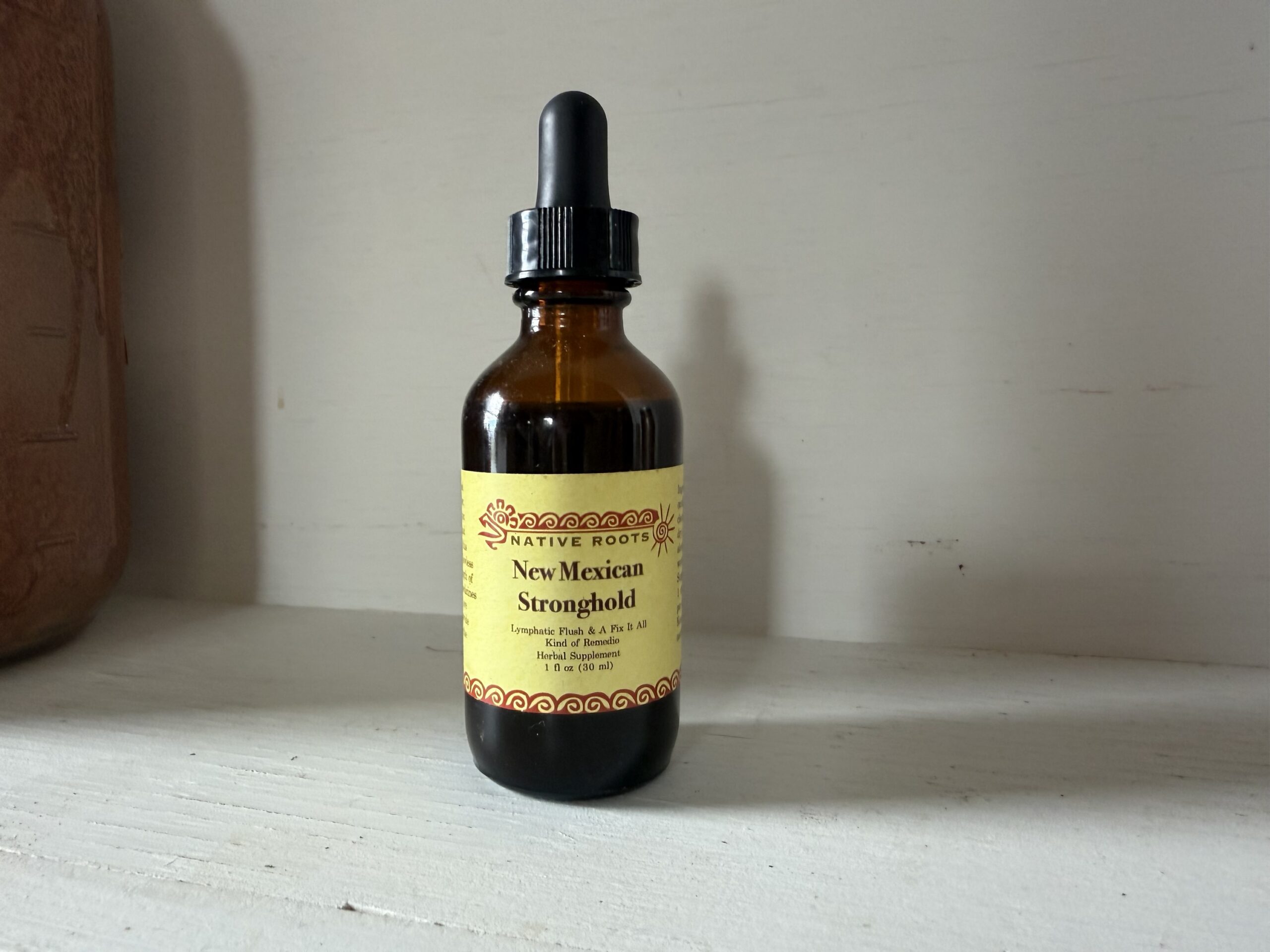
Reviews
There are no reviews yet.